You grow up a little differently when you have a brother who is twelve years older than you are. For starters, cars play a much more important role in your life much sooner, since Brother takes on much of the chauffeuring duties typically left to Mom and Dad. My middle brother and I saw the town in spiffier wheels than most, an orange—sorry, vermillion—Ford Maverick ($1999), where we listened to the sounds of The Big 8, a Canadian AM radio station that had wavelength to reach parts of Nebraska, I’m told. It was in that back seat we committed the lyrics of Jackson 5 and Tom Jones songs to memory, all at a volume even I found to be remarkably high.
Your world also gets to be much bigger much sooner with a teenage brother. Part of this had to do with the times, as every seventeen-year-old guy was one draft board ping pong ball away from being “invited” to serve his country in Southeast Asia. Since this was the first war not every American supported, my world was equal parts crayons, Captain Kangaroo, and Walter Cronkite. The rapid and untimely deaths of Martin Luther King and Bobby Kennedy likely didn’t matter as much to my peers, but when the next person in charge of the country had significant sway over how much you’d see your brother for the next few years, it mattered a lot more, both to the brother and to his family. This is also likely why, to this day, I know about the existence of Country Joe McDonald and the Fish, a group whose brief light of fame was lit at Woodstock with a classic Vietnam War protest song.
Other moments were far less noble, like the many Sundays spent at church next to my brother’s elbow as parishioners walked up for communion. With girls clad in the then-fashionable miniskirts, it was just too tempting for him not to lean over during the eucharistic parade with his ratings of the girls’ sartorial efforts. “Six. Five. Three. Whoa. Nine.” I later went on to study Psychology, and when the concept of unlearning was discussed, this event came directly to mind, making the concept far more than abstract.
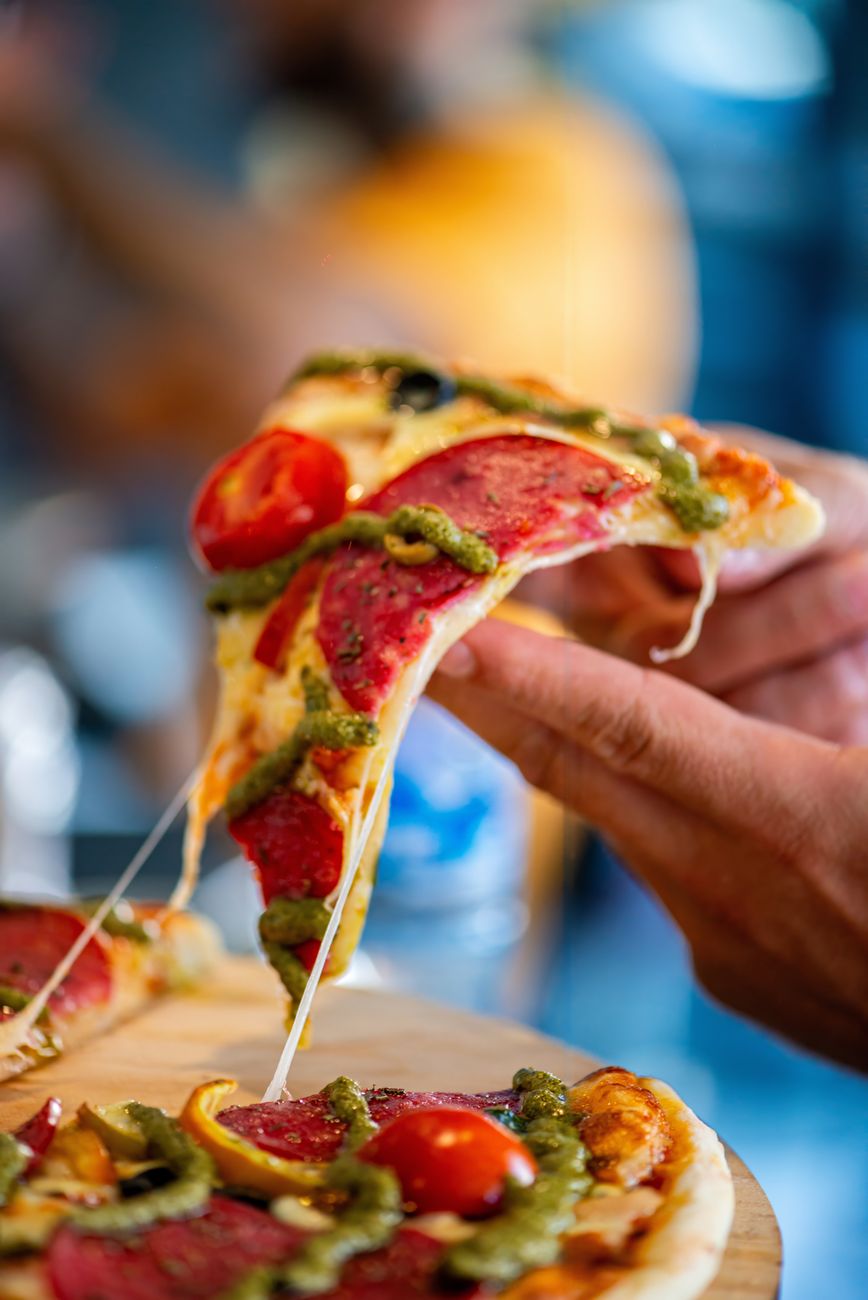
And then there was hockey season. It likely happened no more than once or twice, but my oldest brother was a keen fan in the era of Gordie Howe and Bobby Hull, possessing a puck that flew up in the stands when he was in attendance. When pressed into service as a Saturday night babysitter, his price was always the same—he got to watch hockey, and Dad had to buy pizza.
But not just any pizza. The Little Caesars Sportsman was a meadow of cheese and pepperoni that seemed to go on farther than the eye could see, or most coffee tables could contain. Larger than an extra-large, one slice extended from the tip of my seven-year-old fingers to my elbow, with three end-to-end slices likely rising beyond my head from the ground. Yet all three made it into my stomach, and I went to bed, convinced that, while many days lay ahead in my young life, few would be this satisfying.
I’ve gone on to live a life punctuated by being able to interact meaningfully with older peers who were always surprised by my observations of the world, insights I really couldn’t claim as my own, but simply a result of the luck of the draw. When life requires you to open your eyes a little wider a little sooner, doing so becomes as simple as ABC.
Nametags
An invitation to forced intimacy
One can’t help but balk at the paring of
The black Sharpie
And the blue and white
Hello My Name Is.
So what now?
Conversation of your vocation?
A bad joke?
Awkward discussion of the awkward discussion you’re in?
Judges of music contests say
Don’t listen to the notes
Listen to the music.
Where does it take you?
So look at the person
Not the badge
The way they hold their mouth
How their hair is parted
The pin on their lapel.
Find their inner Shostakovich
And upon parting
Give them the privilege
Of sounding their names
Hearing their tone of delight
That you asked.
Like what you see? Subscribe for free!
 Six O'Clock Sky
Leave a comment