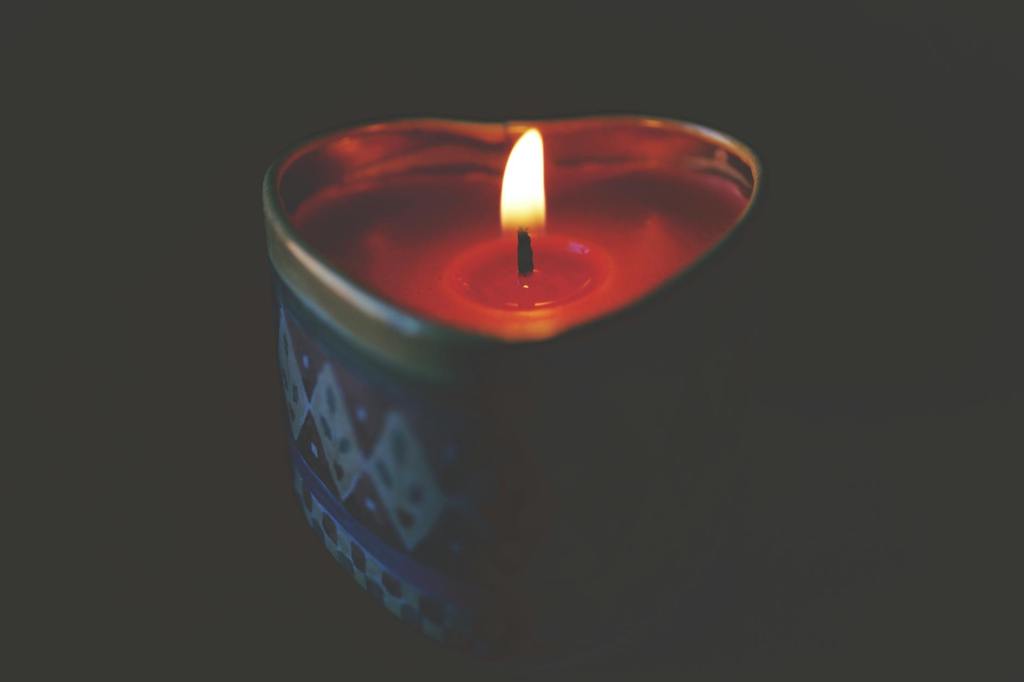
You really owe it to yourself to visit a shop where candles are made by hand. We have such a place in Detroit—Greenfield Village, which is a fascinating amalgamation of cars and early American architecture and all kinds of wonderful things. They have (or at least had) a candle-making demonstration as part of their exhibits, where they mostly made candles of pure beeswax, or pure bayberry. (Back story—in the early 1900s, the tradition was to burn a pure bayberry candle all the way down on New Year’s Eve to have good luck throughout the New Year.) The smell of the shop, combined with the thoughtful focus of the artisan, is a peace-inducing, ethereal memory that stays with me today.
Candles also played an important role in the religious services I was raised in. Little votive lights we lit to pray for personal causes; big candles in red glass holders for major holidays and causes; candelabras of five or six that were lit just because. I have the best recollections from services where some smart minister kept the electric lights low to show off the beauty of the candles, an invitation to set aside the bright, pretend glare of everyday life and its challenges and let the focused, natural, warm light of the candles invite us all to focus as well–on what really matters.
The power of candles came to light (sorry!) recently. The first one was where the world’s best known itinerate preacher tells everyone to let their light shine like a candlestick. The challenge here is twofold. Don’t be falsely modest by dousing your own light with some nutso version of humility, but don’t also think you are personally responsible for lighting all the world, or even all of Yankee Stadium.
Billions of candles have come and gone in history, and not a single one is known to have thought “Hey, my light isn’t filling this whole room. Time to give up.” From all we can tell, candles are content to shine at maximum power (whatever that might be at the time), taking their light with them (in lanterns, for example) and shining the best they can, wherever they are, without a shred of guilt about what they aren’t lighting.
A discussion of light this week brought a reminder of the Berlin Wall falling in 1989. In its day, the Wall was like the Death Star, the symbol of everything wrong with the world—and while it’s hard to say just why, there finally came a time when average citizens decided it was time for it to go.
After a few days of protests that got bigger and bigger, police anticipated some kind of riot was in store. That night, the Wall saw a massive turnout, to be sure, a turnout of people who came in silence, holding only candles. The Wall soon fell. In one of my favorite quotes on world policy, a German leader is credited with saying “We were prepared to deal with everything except prayers and candles.”
This led to two more reminders. One is Dr. Martin Luther King, a light for us all, whose life was testimony to his famous saying “Darkness cannot drive out darkness; only light can do that. Hate cannot drive out hate; only love can do that.”
The other reminder is the monks who just finished a 108-day trek across the country, through some very tough weather, and some very tough physical and mental terrain. They were greeted at Washington’s National Cathedral, having extinguished some serious darkness.
But they didn’t carry any candles. They were the candles.
January Pizzelle
Un grande bicchiere di latte
Vicino al camino.
Rinnovando.
Like what you see? Subscribe for free!
 Six O'Clock Sky
Leave a comment