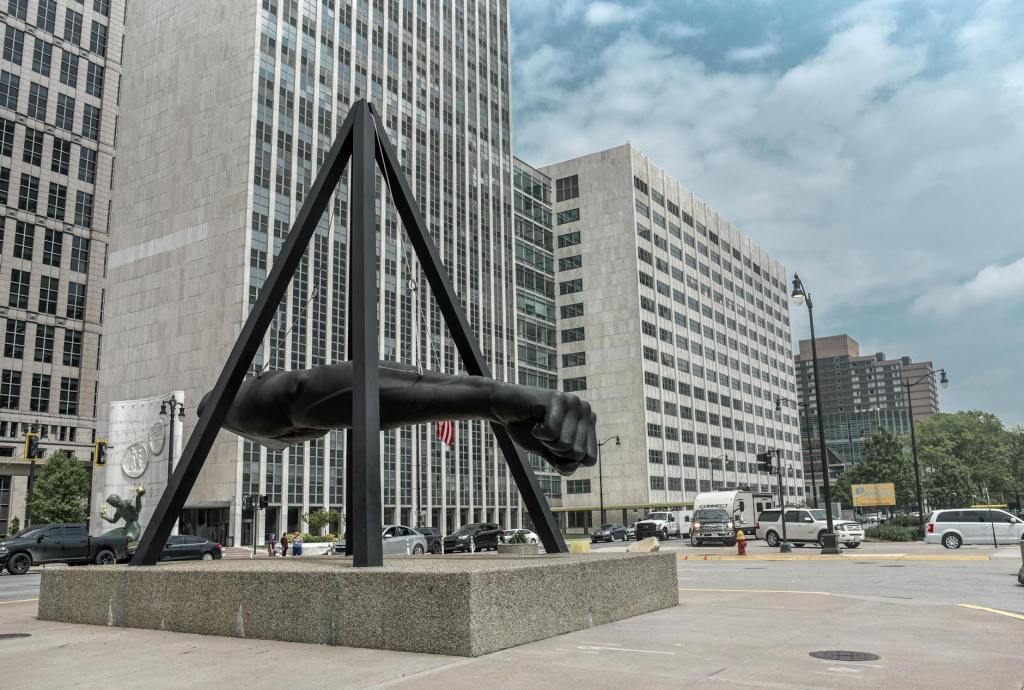
Detroit had long spent more money than it had made. Property values had tanked in the 70s and 80s, so the few homeowners left were already being taxed to the hilt, and storefronts were dark, since most small businesses followed residents to the suburbs. One mayor tried to refinance the city’s burgeoning debt, finally coming up with a plan that was so creative, a banking association gave him an award for innovative fund allocation.
When the people who make money from refinancing give you an award, you should know you’ve really screwed up—and just a few years later, the chickens came home to roost. Detroit was the first major city to declare bankruptcy—but unlike a business or a household, you can’t exactly sell a city off for its parts. What to do?
Into this morass stepped Kevyn Orr, a self-effacing guy who was appointed emergency manager by the governor. It would have been nice for the state to do a little bit more for the city that put Michigan on the map, but that isn’t exactly what happened. For what seemed a very, very, very long time, the state looked at the city, the city looked at local philanthropic organizations (most funded by auto magnets from the time the industry started, so these aren’t small organizations), and they looked to the state, all without blinking.
This was where things stood one Friday afternoon, when Kevyn Orr stepped to a bank of microphones to give his weekly, and what some were seeing as predictable, update on the state of the city. No, there were no financial agreements. No, no one was suing the state. But we have had some lawyers looking at our situation, and the good news is that, if we do have to sell some city assets, it’s likely we’ll still be able to keep all the artwork in the Detroit Institute of Arts. Have a good weekend.
Most people forgot, or never knew, that the DIA is one of the largest publicly held collections of art in the world (including what is largely considered as Diego Rivera’s most famous mural). They didn’t used to call Detroit The Paris of the Midwest for nothing—it’s just that it had been so long ago, that status was off most everyone’s radar screen.
Kevyn Orr’s seemingly innocuous remark at a weekly press conference jumped it back onto everyone’s To Do list, including a ton of influential suburbanites, many of whom hadn’t given Detroit a second thought since they left the city and took their companies with them. Since “likely” wasn’t good enough of a guarantee to save the art, everyone started talking with each other, with enough movers and shakers joining the conversation that state government couldn’t help but jump in. Agreements were struck, a plan was made, and, with the exception of city pensioners who really took a hit, everyone moved forward.
People with MBAs are going to tell you that isn’t how it happened. They’re going to talk about court proceedings, chapters of bankruptcy, and spreadsheets with columns that went into four letters for their headings. That’s all very interesting, but these folks have never had a Coney Dog, never drank a Vernor’s, don’t know we once had both a Wonder Bread and a Twinkies factory, or that Thomas Edison’s best friend was Henry Ford.
This is Detroit. We don’t lead with bluster. It’s a discussion at the Tigers game, beers shared over two barstools, or, in this case, a guy who landed a single sentence with pinpoint accuracy.
Oh that all the world ran this way.
Synonyms
Discussion
Diplomacy
Statesmanship
Engagement
Consideration
Reflection
Concession
Compromise
Respect
Facebook
Oh that it were so.
Like what you see? Subscribe for free!
 Six O'Clock Sky
Leave a comment