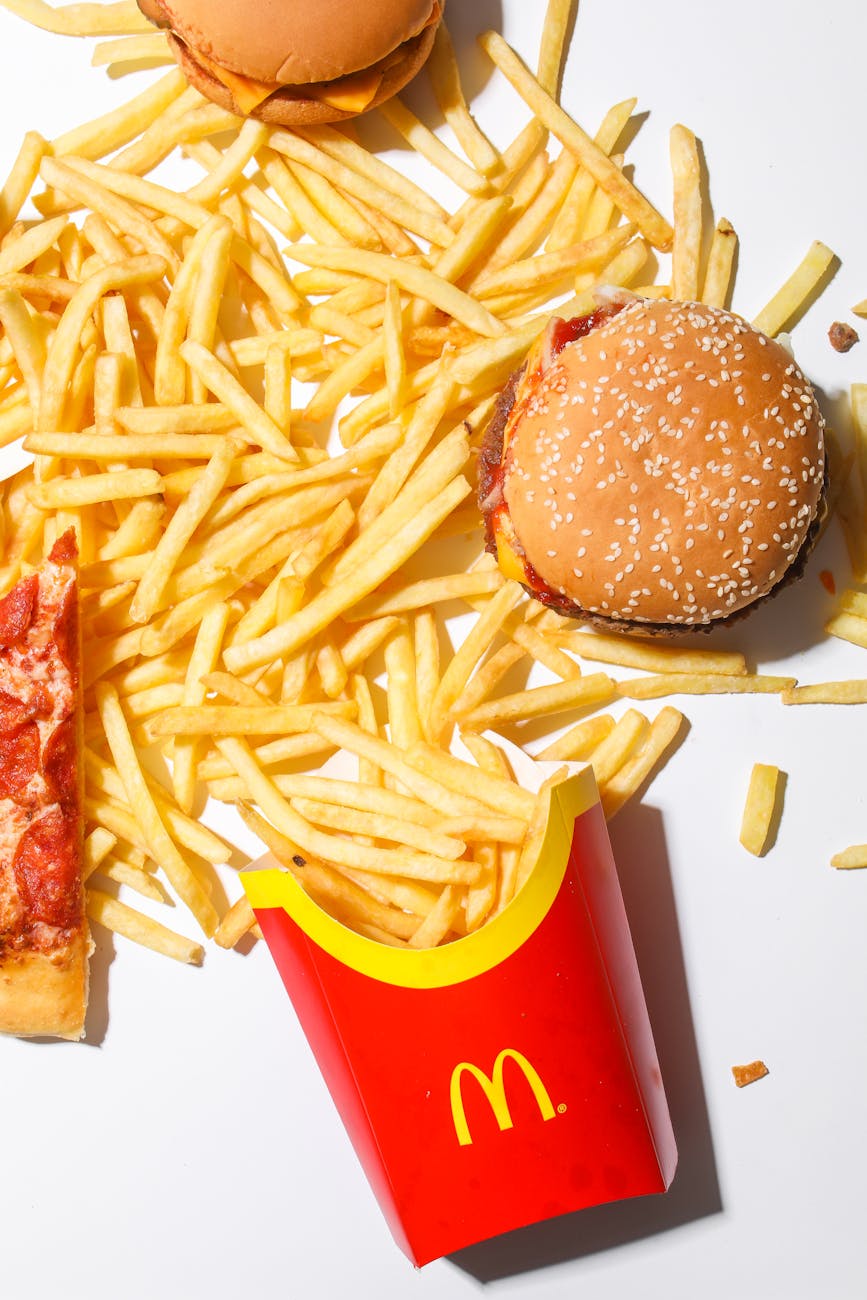
My oldest brother was asked to pick up my other brother and me from our piano lessons. Joe decided to make a trip out of it, so he left a little early to swing by the nearby McDonald’s, which was boasting its then-newest product, the Big Mac. He’d heard good things, and, always one who liked good things, Joe bought four of them.
All for himself.
He ate one as soon as he got back in the car from McDonald’s (drive through? In 1968? Please!) He ate another while going through the car wash. He ate another en route to the piano lesson pickup, polishing off the last half of #3 as my other brother and I loaded into the car. Big Mac 4 was finished on the way home.
This gastronomic adventure was testimony to consumerism, youthful appetites, and the power of the imagination, all key elements to McDonald’s success. I ate tons of McDonald’s cheeseburgers in my two-year commute to grad school (for better or worse, the cheese glues everything together, for easier one-handed eating while driving), but the Big Mac is still my favorite McMenu item, with the Filet-O-Fish in the running as well. Something about those sauces.
It turns out imagination had a lot to do with the founding of McDonald’s, not once, but twice. The Founder is primarily a film based on Ray Kroc’s success as the kingpin of McDonald’s, but there’s a subplot deserving of attention as well. The early part of the film includes a narrative by Dick and Mac McDonald on their very unstructured journey to creating the food preparation system that liberated take-out food from long waits and car hops. Rich with false starts and moments of giving up hope, it is hard not to root for them as they recall the risks they took, and the number of times they had to go backward to go forward. If there is a prototype of all that is good about the American spirit, this is it.
Then there’s Ray Kroc. Ray was the business partner of the McDonald brothers, showing up long after they’d put in the hard work of founding the revolutionary cooking system, and after they tried to franchise the idea, but flopped. Ray brought a different perspective to the franchising idea, and, thanks to advice that changed McDonald’s from a burger-company to a burger-and-real-estate company, his vision made McDonald’s the global behemoth it is today.
As is the case with American consumerism, all is not well that seems to end well. Ray often broke his contract with the brothers, created a company with their name without their consent, and ultimately led to a legal settlement that gave each brother $1 million, but only with a handshake deal for annual royalties on the restaurants that bear their name—a deal Ray never fulfilled.
The story shows two sides of the American dream, a story that rings all too true in today’s political climate. Dick and Mac are the bootstrappers; work hard, don’t be afraid to fail, and you’ll get your due. Ray Kroc worked hard as well, but once things got going, the American dream became just his dream, breaking contracts, partnerships, and hearts along the way.
The challenge about living the good life is when the ends justify the means, when the optimism of “the sky’s the limit” fueling creativity turns into a desire for more than isn’t always better. Then again, if Ray Kroc had been forced to settle for something less, would he have bothered with McDonald’s at all?
I might still be at my piano lesson.
Verdant
A lush garden
Replete
With histories of winters
Frozen spring rains
And fall gales tossing
Its pollen askew
And taking in the pollen orphans
Of others.
A rookie
One with no inside track
On the job wisdom
Time tested vision
Taking in others as well.
One word that speaks
Of length in the tooth
And vision unaware
Embracing
Both ends of a spectrum
But never the middle
The way one
Should use toothpaste.
A tribute to structure
That hibernates
The day we are late for the office.
Like what you see? Subscribe for free!
 Six O'Clock Sky
Leave a comment